RastrAI becomes Microsoft AI Cloud Partner
Breaking News
We are extremely Delighted to share that RastrAI is a Microsoft AI Cloud Partner.
The Microsoft AI Cloud Partner Program is a comprehensive initiative designed to empower businesses by integrating advanced AI capabilities into their cloud solutions. By partnering with Microsoft, organizations gain access to cutting-edge AI tools, resources, and support, enabling them to develop innovative, scalable applications that leverage the power of AI.
This program offers partners the opportunity to enhance their service offerings, improve operational efficiency, and drive business growth through AI-driven insights and automation. Whether you're looking to modernize your infrastructure, optimize data analytics, or create intelligent applications, the Microsoft AI Cloud Partner Program provides the expertise and technology to help you achieve your goals.

Breaking News
RastrAI has been recognized at the Mastercard AI Garage & WiDS Worldwide Awards under the Women in AI category. The recognition highlights the company’s impactful contributions in the areas of Artificial Intelligence, Machine Learning, Data Science, and Large Language Models (LLMs).
This initiative by Mastercard aims to celebrate and empower women entrepreneurs driving innovation in AI, particularly from underrepresented regions. The recognition of Zonunfeli Ralte, Founder of RastrAI, underscores the growing presence and influence of women-led startups from the Northeast and Tier-2/Tier-3 cities of India in the country’s emerging AI ecosystem.

Breaking News
RastrAI has published a research paper with Springer Nature titled “Toward Foundation Models: A Simple Approach for Building Large Event Recognition Models [LERM] Using Federated Multi-instance Knowledge Distillation.”
The paper was featured in the Springer Smart Innovation, Systems and Technologies series and got the best paper award (FICTA 2024 Proceedings). The work introduces LERM, a scalable framework for developing large-scale event recognition models through federated multi-instance knowledge distillation, enabling decentralized learning without direct data sharing.
This innovative approach bridges the gap between foundation model development and privacy-preserving federated learning, marking a significant advancement in collaborative AI and multimodal event understanding

Breaking News
Indrajit Kar from RPG group was recently honored to serve as the Chair and Keynote Speaker at the 1st International Conference IEEE APSCON 2025, held at the prestigious IIT Hyderabad. During the event, he had the privilege of presenting his latest work in cutting-edge AI research, highlighting emerging innovations shaping the future of technology.
Reflecting on the experience, Indrajit emphasized the vital role of research as the true driver of innovation. With his unique perspective bridging academia and industry, he noted that research often remains underappreciated in industrial contexts. Yet, it is precisely this commitment to inquiry and experimentation that fuels transformative advancements such as GPT, LLMs, and Generative AI. According to him, without a sustained focus on exploration and discovery, such groundbreaking technologies would never come to life.

Breaking News
RastrAI has published a paper in the IEEE Xplore research paper titled “Agents Are All You Need: Elevating Trading Dynamics with Advanced Generative AI-Driven Conversational LLM Agents and Tools”
The paper explores the application of generative AI and large-language models (LLMs) in trading environments, focusing on conversational agents and associated tools that enhance trading dynamics. It proposes a framework where LLM-based agents interact with trading platforms or users to support decision-making, strategy development, and real-time analysis. The research outlines how such agents can be designed, deployed, and evaluated in real-world financial workflows, showcasing the potential for improved responsiveness, automation, and adaptability in trading systems.

Breaking News
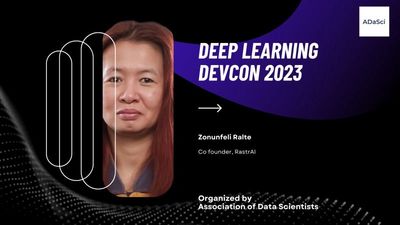
Zonunfeli Ralte presented findings on multi-modal vibration analysis of industrial motors at the DEVCON 2023, organised by Analytics India Magazine. His work, co-authored with Indrajit Kar, uses a cross-attention-based transformer model that fuses thermal (“heat signature”) and acoustic data to improve fault diagnosis in motors. ADaSci
By integrating these two sensor modalities and modelling their interdependencies, the approach outperforms traditional single-modality methods and offers a more robust, accurate means to detect motor faults in industrial settings.
Breaking News
Indrajit Kar from Siemens was invited as a Keynote Speaker at the Indian Institute of Technology, Madras, where he had the honor of receiving a Token of Thanks from Prof. Krishnan Balasubramanian, Professor in the Department of Mechanical Engineering and Head of the Centre for Non-Destructive Evaluation, during Shaastra, IIT Madras an nternational Conference . He also shared the stage with distinguished Data Science leaders, contributing to insightful discussions on the evolving frontiers of AI and cybersecurity.
His keynote talk, focused on the emerging shift toward building reliable and resilient AI systems.
Indrajit emphasized that cybersecurity must adapt to these new adversarial challenges, where Generative Adversarial Machine Learning seeks to deceive models with carefully crafted data. He also introduced the concept of Chaos Engineering—a discipline rooted in chaos theory—to test distributed systems under unpredictable conditions. This approach, he explained, is vital to ensuring that AI systems remain robust, reliable, and resilient even amidst the randomness and uncertainty of the digital age.

Breaking News
RastrAI has published a new IEEE research paper paper titled “Toward More Robust Skull Stripping Using Custom Transformer and Combined Hausdorff Loss.” The work introduces a custom transformer-based architecture dedicated to brain MRI skull-stripping, and pairs it with a combined Hausdorff distance-based loss to enhance boundary precision and overall robustness. The approach is designed to address challenging anatomical variability, imaging artifacts and scanner heterogeneity in skull-stripping pipelines.
By integrating the transformer model’s capability to capture long-range context and the Hausdorff-driven loss to enforce accurate boundary delineation, RastrAI’s contribution marks an advance in automated brain extraction for neuroimaging workflows.
Breaking News
RastrAI has been recognized at the prestigious 3AI ACME Awards 2024 (3rd Edition), where its Founder, Zonunfeli Ralte, received the AI Changemaker Leader Award. The honor celebrates her exceptional leadership and impactful contributions to the fields of Artificial Intelligence and Data Science as a woman entrepreneur.
Presented by 3AI, India’s largest platform for AI and analytics professionals, the ACME Awards acknowledge innovators and leaders who are driving transformative change through AI. This recognition highlights RastrAI’s commitment to developing responsible, scalable, and industry-driven AI solutions, and underscores Zonunfeli’s role in championing women’s leadership and innovation in India’s growing AI ecosystem.

Breaking News
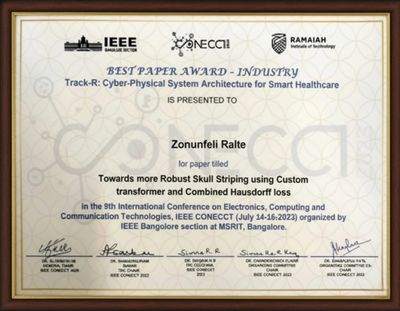
RastrAI has been honored with the Best Paper Award for its IEEE publication titled “Toward More Robust Skull Stripping Using Custom Transformer and Combined Hausdorff Loss.”
The paper presents a breakthrough in medical image segmentation, introducing a custom transformer architecture coupled with a Combined Hausdorff Loss function to achieve superior accuracy and robustness in brain MRI skull stripping. This innovative approach enhances boundary precision and generalization across diverse imaging conditions.
The recognition highlights RastrAI’s continued leadership in AI-driven medical imaging research, reaffirming its commitment to advancing reliable, high-performance healthcare AI solutions.
Breaking News
Indrajit Kar and his team from Siemens presented their pioneering work on multi-GPU distributed model parallelism for Aerial Elevation Classification and Image Segmentation at NVIDIA GTC 2022. Their research, titled “Aerial Image Segmentation and Elevation Classification using Knowledge Distillation,” showcased how advanced parallel computing and knowledge distillation techniques can accelerate deep learning workflows while maintaining high accuracy. The approach enables efficient processing of large-scale aerial datasets, making it valuable for applications in geospatial intelligence, urban planning, and environmental monitoring—demonstrating the team’s contribution to scalable and high-performance AI in Earth observation.